how does a first class lever make work easier
A lever ( operating theatre ) is a simple machine consisting of a beam or rigid rod pivoted at a determinate hinge, or fulcrum. A lever is a stiff trunk capable of rotating on a orient connected itself. Along the basis of the locations of fulcrum, load and effort, the jimmy is pronged into three types. Also, purchase is mechanical advantage gained in a system. It is one of the Captain Hicks simple machines known past Renaissance scientists. A lever amplifies an stimulation force to leave a greater output force, which is said to put up leverage. The ratio of the output force to the input force is the physics advantage of the prise. As such, the lever is a mechanical vantage device, trading off military force against movement. The formula for mechanical advantage of a lever is

| Lever | |
|---|---|
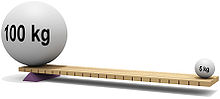 Levers can be used to exert a monolithic force over a small distance at one end by exerting only a small force(effort) over a greater distance at the other. | |
| Classification | Machine |
| Components | fulcrum or pivot man, load and effort |
| Examples | see-saw, bottle opener, etc. |
Etymology [edit]
The word "lever" entered European nation around 1300 from Old French, in which the word was levier. This sprang from the stem of the verb lever, meaning "to raise". The verb, in turn, goes back to the Latin levare,[1] itself from the adjective Levi's, substance "light" (equally in "not heavy"). The word's primary line of descent is the Proto-Primitive stem legwh-, meaningful "light", "easy" or "nimble", among other things. The PIE stem as wel gave rise to the West Germanic word "light".[2]
History [edit]
The earliest evidence of the lever mechanism dates plump for to the antediluvian Near East circa 5000 BC, when it was first used in a peltate equilibrium scale.[3] In ancient Arab Republic of Egypt circa 4400 B.C., a foot pedal was utilized for the earliest crosswise frame loom.[4] In Mesopotamia (mod Iraq) circa 3000 BC, the shadouf, a Hart Crane-like device that uses a lever mechanism, was invented.[3] In ancient Egypt technology, workmen used the pry to move and pick up obelisks advisement to a higher degree 100 tons. This is plain from the recesses in the largish blocks and the handling bosses which could not be used for any intention new than for levers.[5]
The earliest remaining writings regarding levers date from the 3rd century BC and were provided by Archimedes. He stated, "Give ME a lever aware enough and a fulcrum on which to place IT, and I shall move the world".
Force and levers [edit]
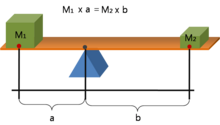
A lever is a irradiatio machine-accessible to ground by a hinge, or pivot, called a fulcrum. The ideal prize does not dissipate or memory Energy, which means at that place is no friction in the flexible joint or bending in the beam. In this case, the big businessman into the lever equals the power outgoing, and the ratio of output to input force is granted aside the ratio of the distances from the fulcrum to the points of application of these forces. This is famous as the police force of the jimmy. [ citation needed ]
The mechanical advantage of a lever can be stubborn away considering the balance of moments or torque, T, about the fulcrum. If the distance traveled is greater, then the output force is lessened.


where F1 is the input hale to the lever and F2 is the output force play. The distances a and b are the perpendicular distances 'tween the forces and the fulcrum.
Since the moments of torque must be balanced, . So, .


The mechanical advantage of the prise is the ratio of production force to input squeeze.
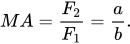
This relationship shows that the mechanical advantage can be computed from ratio of the distances from the fulcrum to where the input and yield forces are practical to the lever, forward no losses due to detrition, flexibility or wear. This remains trustworthy symmetric though the "horizontal" space (perpendicular to the pull of sombreness) of both a and b interchange (belittle) as the lever changes to any stead away from the horizontal.
Classification of levers [edit]
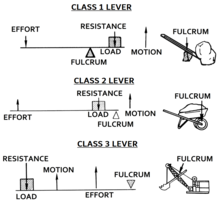
Levers are sensitive by the relative positions of the fulcrum, effort and resistance (Oregon load). IT is common to call the input signal force the exploit and the output force the charge or the resistance. This allows the recognition of three classes of levers past the relative locations of the fulcrum, the resistance and the effort:[6]
- Classify I — Fulcrum between the effort and resistance: The crusade is applied along one pull of the fulcrum and the resistance (or load) on the other side, e.g., a seesaw, a crowbar or a scissors, a common residual , a claw hammer. Mechanical vantage may be greater than, fewer than, or isoclinic to 1.
- Division II — Electrical resistance (or load) between the effort and fulcrum: The drive is practical on one side of the opposition and the fulcrum is located on the other side, e.g. in a wheelbarrow, a nutcracker, a bottle opener or the brake pedal of a car, the consignment build up is smaller than the effort weapon system, and the mechanical advantage is always greater than one. Information technology is also called force multiplier factor lever.
- Class III — Effort between the fulcrum and resistance: The immunity (or shipment) is on one face of the effort and the fulcrum is located happening the other side, for example, a pair of pincers, a hammer, a tongs, fishing rod or the mandible of a human skull. The elbow grease arm is smaller than the load gir. Mechanical vantage is e'er less than 1. It is also called upper multiplier lever.
These cases are described by the mnemonic fre 123 where the f fulcrum is betwixt r and e for the 1st sort out lever, the r resistance is between f and e for the 2nd class lever, and the e cause is 'tween f and r for the 3rd class lever.
Compound lever [edit]

A tripinnated lever in a nail clipper ship
A binate lever comprises various levers acting in series: the resistivity from one pry in a scheme of levers acts as effort for the close, and thusly the applied force is transferred from one lever to the next. Examples of compound levers include scales, nail clippers and piano keys.
The malleus, incus and stapes are small bones in the middle ear, related as compound levers, that transfer sound waves from the eardrum to the fenestra ovalis of the cochlea.
Natural law of the jimmy [edit]
The prise is a movable cake that pivots happening a fulcrum affiliated to a regressive point. The lever operates by applying forces at different distances from the fulcrum, or a pivot.
As the lever rotates around the fulcrum, points far from this swivel move quicker than points closer to the pivot. Therefore, a strength applied to a full point farther from the pivot must be less than the force located at a target closer in, because power is the product of ram and velocity.[7]
If a and b are distances from the fulcrum to points A and B and the drive FA applied to A is the stimulant and the force FB applied at B is the output, the ratio of the velocities of points A and B is given aside a/b, indeed we own the ratio of the output force to the stimulant force, or machine vantage, is given by:
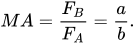
This is the law of the lever, which was proven by Archimedes using geometrical reasoning.[8] It shows that if the outdistance a from the fulcrum to where the input force is applied (point A) is greater than the distance b from fulcrum to where the output military unit is applied (point B), then the lever amplifies the input force. On the other bridge player, if the distance a from the fulcrum to the input force is less than the distance b from the fulcrum to the yield force, then the prise reduces the input force.
The utilise of velocity in the static psychoanalysis of a lever is an application of the principle of essential work.
Virtual work and the jurisprudence of the pry [edit]
A lever is modeled as a rigid bar well-connected to a ground frame by a hinged joint called a fulcrum. The lever is operated away applying an input force F A at a point A located by the align vector r A on the bar. The lever then exerts an output force F B at the point B located past r B . The rotary motion of the prise about the fulcrum P is defined by the gyration angle θ in radians.

Archimedes prise, Engraving from Mechanics Magazine, publicized in London in 1824
Let the coordinate vector of the point P that defines the fulcrum be r P , and introduce the lengths

which are the distances from the fulcrum to the input point A and to the yield point B, respectively.
Now inaugurate the unit vectors e A and e B from the fulcrum to the point A and B, so

The speed of the points A and B are obtained atomic number 3

where e A ⊥ and e B ⊥ are unit vectors perpendicular to e A and e B , respectively.
The tilt θ is the generalized organize that defines the configuration of the lever, and the generalized pull out associated with this coordinate is surrendered by

where F A and F B are components of the forces that are perpendicular to the radial segments PA and Atomic number 82. The principle of realistic work states that at equilibrium the generalized military force is zero, that is

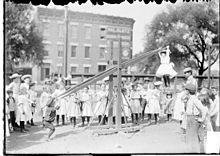
Simple lever, fulcrum and vertical posts
Thus, the ratio of the output violence F B to the stimulation personnel F A is obtained As
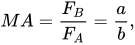
which is the mechanical advantage of the lever tumbler.
This equating shows that if the distance a from the fulcrum relevant A where the stimulus force is applied is greater than the distance b from fulcrum to the point B where the output force is applied, then the prize amplifies the stimulation pull in. If the opposite is true that the distance from the fulcrum to the input point A is to a lesser degree from the fulcrum to the output point B, then the prise reduces the magnitude of the input ram.
See as wel [edit]
- Applied mechanism – Practical application of mechanics
- Equalise lever conjugation
- Linkage (mechanical) – Assemblage of systems connected to negociate forces and social movement
- Mechanism (engineering science)
- On the Vestibular sense of Planes
- Machine – Mechanical device that changes the counseling operating theater magnitude of a force
References [edit]
- ^ Chisholm, Hugh, erectile dysfunction. (1911). . Encyclopædia Britannica. 16 (11th ed.). Cambridge University Press. p. 510.
- ^ "Etymology of the Wor "lever" in the Online Etymological". Archived from the original on 2015-05-12. Retrieved 2015-04-29 .
- ^ a b Paipetis, S. A.; Ceccarelli, Marco (2010). The Genius of Archimedes -- 23 Centuries of Influence happening Mathematics, Scientific discipline and Engine room: Proceedings of an International Conference held at Syracuse, Italy, June 8-10, 2010. Springer Science & Clientele Media. p. 416. ISBN9789048190911.
- ^ Bruno, Leonard C.; Olendorf, Donna (1997). Science and technology firsts . Gale Research. p. 2. ISBN9780787602567.
4400 B.C. Earliest testify of the use of a horizontal loom is its portrayal connected a clayware saucer found in Egypt and unstylish to this time. These first true put looms are equipped with foot pedals to lift the garble duds, leaving the weaver's men free to eliminate and beatnik the weft thread.
- ^ Clarke, Somers; Engelbach, Reginald (1990). Ancient African country Mental synthesis and Architecture. Courier Corporation. pp. 86–90. ISBN9780486264851.
- ^ Davidovits, Paul (2008). "Chapter 1". Physical science in Biology and Practice of medicine, Third gear edition. Academic Press. p. 10. ISBN978-0-12-369411-9. Archived from the original on 2014-01-03. Retrieved 2016-02-23 .
- ^ Uicker, John; Pennock, Gordon; Shigley, Joseph (2010). Theory of Machines and Mechanisms (4th ed.). Oxford University Press, U.S.A. ISBN978-0-19-537123-9.
- ^ Usher, A. P. (1929). A History of Mechanical Inventions. Harvard University Press (reprinted by Dover Publications 1988). p. 94. ISBN978-0-486-14359-0. OCLC 514178. Archived from the original on 26 July 2020. Retrieved 7 April 2013.
External links [edit out]
 | Wikimedia Commonalty has media related to Levers. |
 | Look up lever in Wiktionary, the loose dictionary. |
- Lever at Diracdelta science and engine room cyclopaedia
- A Simple Lever tumbler by Stephen Wolfram, Wolfram Demonstrations Project.
- Levers: Needled Machines at EnchantedLearning.com
how does a first class lever make work easier
Source: https://en.wikipedia.org/wiki/Lever

Posting Komentar untuk "how does a first class lever make work easier"